Free IBAN Checker: Validate Your IBAN Number Online
An IBAN checker confirms whether an International Bank Account Number is correctly structured, and ours does more than check the format. Paste an IBAN below and it also checks the domestic account number against country-specific rules where supported, tells you whether the IBAN's country participates in the Single Euro Payments Area, and looks up the bank behind it where that data is on record.
How to Use the IBAN Checker
- Enter the IBAN. Type or paste it into the field above.
- Run the check. The check covers character format, country support, length, structure, and the check digit.
- Read each result. Each of the five structural checks returns its own pass or fail, so a rejected IBAN tells you which rule it broke. The domestic checksum is reported separately and returns valid, invalid, or unknown.
- Review the bank data. The country and account number are parsed from the IBAN string. Bank code and branch code are also shown, where the country's structure includes them. Where our data covers the country, we also resolve registry details such as the BIC, bank name, city, and address.
What Is an IBAN Number?
An IBAN (International Bank Account Number) is a standardised code that identifies a specific bank account for domestic and international payments in the countries that use the standard. Its structure is defined by ISO 13616-1:2020, the international standard that specifies the elements of an IBAN so account data can be processed automatically across borders and between industries. At the top level, every IBAN combines a country code and two check digits with a domestic banking number called the BBAN. The BBAN's own internal structure, how it splits into a bank code, branch code, and account number, varies by country.
Because the check digits are calculated from the rest of the IBAN, many mistyped IBANs will fail this check, which can catch an error before a payment is attempted rather than after a transfer fails.
The Parts of a Valid Example IBAN
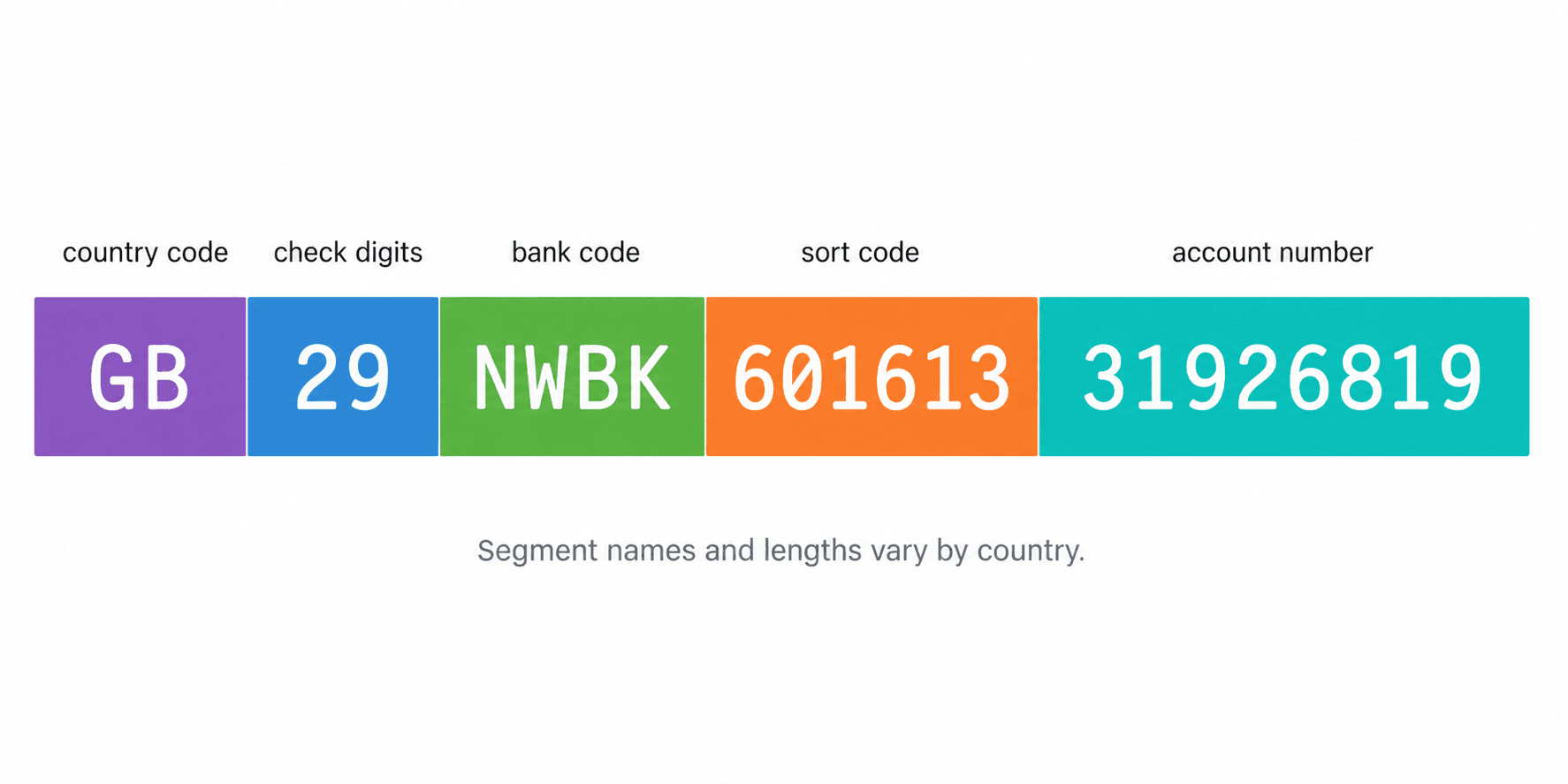
- Country code. Two letters identifying the IBAN country, using the ISO 3166-1 alpha-2 standard (GB, DE, FR, ES).
- Check digits. Two digits calculated from the rest of the IBAN using the MOD 97-10 scheme defined in ISO/IEC 7064 and required by ISO 13616-1. These validate the IBAN as a whole.
- Bank code. A segment of the BBAN that identifies the institution in most countries' IBAN structures.
- Branch or sort code. Present in some countries as its own segment, such as the six-digit sort code in a UK IBAN. Other countries fold branch information into the bank code or omit it.
- Account number. The domestic account number that identifies your specific account at the bank.
bban field in our API response, which reports a checksum result for that domestic part rather than the account number itself.IBAN number length is fixed per country but differs between them. A Norwegian IBAN is 15 characters, a UK or German IBAN is 22, and a French IBAN is 27. These are country-specific examples, not a universal template, since the internal layout of an IBAN varies by country even where the total length happens to match. Our checker holds the expected length for each supported country and tests yours against the right one.
Reading the Account Number in an IBAN
The account number embedded in an IBAN is generally the same domestic account number your bank uses internally, though the exact relationship between the two, and where the account number sits within the IBAN, depends on the country's own BBAN structure.
31926819 in GB29 NWBK 601613 31926819. For a DE IBAN, the standard structure places it in the last 10. Our API returns the account portion as a separate field, so you can confirm the underlying number matches what you expect.This extraction is useful beyond a one-off check. If a customer read you their account number over the phone and later sent an IBAN through a form, comparing the two here by eye is faster than counting digits manually.
What the IBAN Checker Validates
Our checker runs five structural tests, so you can see the reason behind the result rather than guessing at it. Each of these five returns its own pass or fail:
- Character format. Confirms the IBAN contains only alphanumeric characters.
- Country support. Confirms the two-letter prefix belongs to a country that uses the IBAN standard. This is why a string beginning with US fails this check: the United States is not among the countries that use the IBAN standard, so
is_iban_supported_countryreturns false. - Length. Compares the IBAN against the exact character count defined for its country.
- Structure. Confirms the IBAN's overall structure, meaning the arrangement and character types of its segments, matches the expected pattern for its country.
- Check digit. Recalculates the MOD 97-10 checksum and compares it against the two digits carried in the IBAN. This is the check that catches most ordinary typos.
Separately, for eight countries where domestic account number validation is supported, GB, DE, FR, IT, ES, NL, SE, and BE, we also report a bban checksum result of valid or invalid. For all other countries this field returns unknown, and the five structural tests above are your integrity signal.
Bank Data and SEPA Eligibility
Bank data coverage varies by country. GB, PK, IE, GI, BH, and AZ can resolve the full registry set: BIC, bank name, city, and address, when the bank is in our data. DE can resolve the bank name and BIC. SE can resolve the bank name. An IBAN can be perfectly valid and still return no registry data.
The SEPA result reflects whether the IBAN's country participates in the Single Euro Payments Area scheme, shown as Yes, No, or N/A when that data isn't available for the IBAN. It does not confirm that a specific account or payment will be treated as SEPA eligible in practice. The relevant payment accounts, PSPs, and payment route must also support the scheme.
Inside SEPA, a beneficiary's BIC is not required for a euro credit transfer. The IBAN alone meets that specific requirement, though other information is still needed to complete a payment. This has been the case for cross-border SEPA payments since 1 February 2016 under Regulation (EU) 260/2012. Outside SEPA, or for non-euro wires, requirements vary by payment corridor, currency, destination, bank, and correspondent bank, so confirm what's required directly with the receiving bank.
Where This Comes in Handy
- Checking a number someone sent you. Before you act on an IBAN from an email, invoice, or spreadsheet, paste it here to catch an obvious typo or formatting mistake without opening a spreadsheet formula or calling your bank.
- Confirming your own IBAN. Check that the number on your card, in your banking app, or on a form you filled in by hand is well-formed before you hand it to someone else.
- A quick check while you build. Spot-check example or test IBANs by hand as you develop, then move the same checks into your application through the IBAN Validation API.