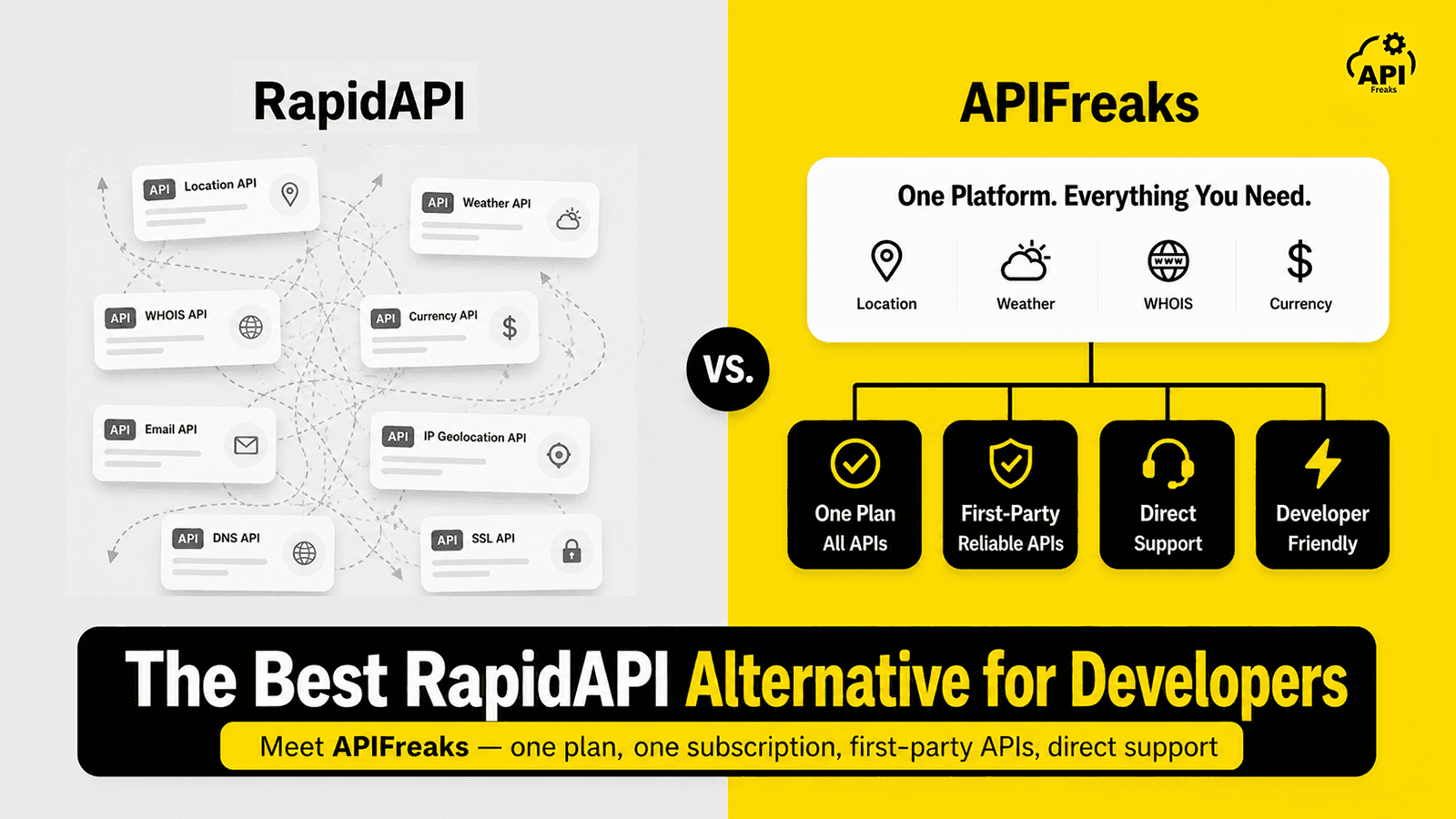

If you're looking for a RapidAPI alternative, you already know why. Maybe the billing didn't add up. Maybe support pointed fingers instead of fixing things. Maybe an API that worked fine last week quietly stopped working. Whatever it was, the frustration is legitimate.
Maybe it was the overage charge that appeared after a rough billing cycle — one you had no way to cap in advance. Maybe it was a support ticket bouncing between RapidAPI and the API provider for a week while your production app sat broken. Or maybe it was an API that worked fine in staging, silently degraded in production, and neither party fully owned the problem.
This post lays out what a genuine RapidAPI alternative looks like, why the marketplace model creates the problems it does, and why APIFreaks — a first-party API platform — is the platform developers and AI engineers have been looking for.
What Is RapidAPI?
RapidAPI is an API marketplace that connects developers to APIs from independent third-party providers through a single dashboard. One login, one key, unified subscription management — instead of juggling separate vendor accounts for every API you need.
The model solved a real problem when it launched. But aggregating independent providers also introduces structural trade-offs — in billing, quality consistency, and support — that become harder to ignore the more seriously you build on the APIs you're consuming.
Understanding those trade-offs is the key to choosing the right RapidAPI alternative.
Why Developers Look for a RapidAPI Alternative
Before evaluating any alternative, it helps to name what's actually broken. Developers leave RapidAPI — or start searching for alternatives — for a predictable set of reasons:
1. Unpredictable billing and overage charges RapidAPI charges a 25% platform commission on all transactions (raised from 20% following Nokia's acquisition). On top of that, overage charges are billed after usage, not capped upfront. A code bug or unexpected traffic spike can translate into a billing cycle that looks nothing like what you planned. RapidAPI's own documentation is explicit: monitoring your usage and selecting the right plan is your responsibility.
2. Inconsistent API quality across providers Quality varies dramatically depending on who built and maintains each individual API. Documentation depth, error handling, response schema consistency, and uptime behavior are all outside the platform's control — they belong to the provider. RapidAPI has no authority over what any given provider ships.
3. Fragmented, finger-pointing support When an API breaks, the immediate question is: is this a RapidAPI platform issue or a provider issue? Often, neither side fully owns it. The result is a support experience where neither party can resolve the problem unilaterally.
4. Multiple invoices, multiple pricing structures Using APIs from five different providers means five separate pricing logics, five rate limit behaviors, and billing that technically consolidates but practically fragments. Every new provider adds integration and billing complexity.
5. Poor fit for AI agent workflows Marketplace APIs with variable response schemas and inconsistent error formats are a poor fit for MCP-based AI agent pipelines, which require clean, predictable, structured data.
These aren't niche complaints. They come up consistently across developer forums, review platforms, and support channels — and they all trace back to the same root cause: the marketplace model.
At a Glance: RapidAPI vs APIFreaks
RapidAPI | APIFreaks | |
|---|---|---|
API ownership | Third-party providers | First-party only |
Billing model | Per-provider + 25% platform commission | Single unified subscription |
Overage charges | Billed after usage | Defined upfront, no surprises |
Invoice sources | Multiple | One |
Platform commission | 25% (raised from 20%) | None |
API consistency | Varies per provider | Uniform across all APIs |
Customer support | Fragmented — platform vs provider | Centralised, one team |
AI / MCP agent ready | Limited | Yes — structured for agent workflows |
Cost predictability | Variable | Fixed |
What Is APIFreaks? How It Differs from RapidAPI
APIFreaks is a first-party API platform. Every API in the APIFreaks catalogue is built, owned, and maintained by APIFreaks directly — there are no third-party providers behind any of it. One subscription covers the entire catalogue. One invoice. One support team.
That's the fundamental difference from RapidAPI. RapidAPI aggregates APIs from thousands of independent providers — it centralizes key management and discovery, but the actual API product (its uptime, documentation, response structure, error handling) lives with whoever built it. RapidAPI is the storefront. The provider is the shop. This model scales for discovery. It doesn't scale for dependability.
APIFreaks owns the shop. Every API comes from the same engineering process, follows the same documentation standards, and is supported by the same team. Quality standards, error formats, and rate limit behavior are uniform across the entire catalogue — because there's only one team setting them. That architectural difference is what drives every downstream distinction: in billing, consistency, support, and reliability.
Pricing & Billing: The Real Cost of the Marketplace Model

Billing is where the RapidAPI alternative conversation gets most urgent — because the marketplace model creates structural billing risks that don't exist on a unified platform.
RapidAPI's commission: Nokia/RapidAPI takes a flat 25% fee on every transaction. That's embedded in what providers charge. On a $100/month subscription, roughly $25 goes to the platform before the provider sees anything — and that cost flows through to your pricing one way or another.
Overage charges: If your usage exceeds a plan's quota, charges are billed after the fact. Some providers allow hard limits; many don't. The result: a month where a single runaway process can generate charges you didn't budget for, with no ceiling to catch it.
Multi-provider billing: Each provider on RapidAPI runs its own pricing logic. Using five APIs means five separate quota structures, five rate limit behaviors, and billing that consolidates at the surface but fragments underneath. Resolving a dispute requires identifying which provider the issue traces to — and that coordination takes time.
APIFreaks by design: One flat subscription. Your cost is fixed before the month starts. No platform commission. No structural mechanism for surprise charges. No multi-party billing disputes.
RapidAPI | APIFreaks | |
|---|---|---|
Billing model | Per-provider + platform commission | Single flat subscription |
Platform commission | 25% | None |
Overage policy | Charged after usage | Defined upfront |
Number of invoices | Multiple (per provider) | One |
Cost predictability | Unpredictable | Fully predictable |
Mid-month surprises | Possible | Not possible |
APIFreaks plans start from a single flat monthly subscription — see pricing →
No platform commission. No overage surprises. One invoice.
One Platform. One Subscription. One Invoice. All the APIs You Need.
API Quality & Consistency: Owned vs Aggregated

On any API marketplace, quality is as variable as the providers themselves.
Some providers on RapidAPI are excellent — well-documented, actively maintained, with thoughtful error handling and stable response schemas. Others are the opposite: stale documentation, inconsistent response structures, error messages that tell you nothing, and no clear indication of whether a degraded endpoint is temporary or permanent. The platform can surface these APIs, but it can't standardize what they do.
This creates real production risk. An API that worked last month may have changed its response structure without notice. A provider may have stopped maintaining an endpoint entirely. A pricing plan may have been deprecated. None of these events necessarily trigger a platform-level alert from RapidAPI, because RapidAPI doesn't own the API — the provider does.
For prototypes and side projects, this variability is manageable. For production applications where downstream services depend on consistent data, it's a reliability problem. Inconsistent error formats mean your error handling has to be written differently for every API you consume. Different rate limit behaviors mean your retry logic can't be generic.
APIFreaks eliminates this variability by design. Every API is first-party. Documentation standards, error formats, response schemas, and rate limit behavior are consistent across the entire catalogue. You learn the pattern once, and it holds everywhere in the platform.
Customer Support That Actually Owns the Problem
Here's a support scenario that plays out regularly on API marketplaces:
An API you depend on starts returning errors. You open a ticket. RapidAPI's team says it looks like a provider issue. The provider says nothing on their end has changed and suspects a platform proxy problem. You're now in the middle of a conversation between two parties who each believe the problem belongs to the other — while your application is broken.
This isn't a failure of individuals. It's a structural consequence of the marketplace model. When the platform and the API product are owned by different entities, accountability gaps exist by architecture. Neither side is being evasive — they genuinely may not know. The gap is built in.
On APIFreaks, that gap doesn't exist. The same team that built the API maintains it and answers support tickets when something breaks. There's no routing toward an upstream provider. Support is the provider. One team, one chain of accountability, no finger-pointing because there's no one else to point at.
For teams where downtime has a real dollar cost, this is not a minor differentiator.
One team. One ticket. No runaround. Try APIFreaks →
Built for Developers. Ready for AI Agents.
APIFreaks is built for developers first. But its architecture also makes it a strong fit for the AI engineer workflow that's become increasingly common: building AI agents using MCP-compatible tool pipelines.
MCP — the Model Context Protocol, introduced by Anthropic and now adopted across OpenAI, Google Gemini, and most major AI platforms — defines a standardized way for AI agents to discover and call external tools. Agents send structured requests; they expect structured, predictable responses. The standard is clean by design.
The problem with marketplace APIs in agent pipelines is the same problem they have in production integrations: variable response schemas and inconsistent error formats add overhead that shouldn't be there. An agent that hits an unexpected schema doesn't debug interactively — it fails, or produces unreliable output. You end up doing prompt engineering to compensate for an API quality problem.
APIFreaks's first-party APIs remove that overhead entirely:
- Consistent response schemas — agents get predictable data on every call, from every API in the catalogue
- Uniform error formats — error handling logic can be written once and reused across all endpoints
- No custom wrappers needed — APIs plug directly into MCP-compatible agent pipelines as tools, without per-endpoint schema normalization
- Reduced prompt engineering overhead — clean, predictable data means less compensating logic in the agent layer
Whether you're manually integrating an API into an application or wiring a tool into an autonomous agent, APIFreaks is built to serve both use cases without modification.
Shared DNA
It's worth naming what RapidAPI and APIFreaks genuinely agree on — because there's a baseline any serious API hub needs to deliver.
Both platforms offer core data APIs that developers use across a wide range of applications. IP Geolocation, Currency Exchange, Weather, WHOIS, and many more APIs are present on both. Both support organization-level access: team accounts, API key management, and usage dashboards. Both provide a single entry point that replaces the fragmentation of managing direct relationships with multiple vendors.
These capabilities represent the baseline developers now expect from any credible API marketplace or platform. RapidAPI helped establish that baseline. APIFreaks meets it.
The difference is entirely in how each platform delivers on it. RapidAPI through aggregation — bring as many providers together as possible and let developers find what they need. APIFreaks through ownership — build every API in-house and control the quality, consistency, and support end to end.
Same destination. Very different road.
Who Is APIFreaks Built For?
If you are... | Right fit |
|---|---|
Building a production app that needs reliable, consistent APIs | ✅ APIFreaks |
An AI engineer building MCP-based agent workflows | ✅ APIFreaks |
A team that wants one invoice and zero billing surprises | ✅ APIFreaks |
Fed up with support tickets going nowhere | ✅ APIFreaks |
Looking for a RapidAPI alternative with first-party APIs | ✅ APIFreaks |
A developer who wants a single API hub under one roof | ✅ APIFreaks |
One Platform. One Subscription. One Invoice. All the APIs You Need.
RapidAPI helped normalize the API marketplace concept. It made API discovery easier, centralized key management, and gave developers a single login for hundreds of services. That's a genuine contribution to the ecosystem.
But the marketplace model carries structural costs — billing unpredictability, inconsistent API quality, fragmented support accountability — that compound as you move from exploration into production. The things that make a marketplace convenient for browsing are often the same things that make it unreliable to build on.
If you're searching for a RapidAPI alternative because the marketplace model has let you down, the answer isn't a better marketplace. It's a platform that owns what it offers.
RapidAPI helped normalize the API marketplace. APIFreaks is what the API platform should have been all along.
Explore APIFreaks → | Browse the full API catalogue →
Frequently Asked Questions
What is the best RapidAPI alternative for developers?
For developers who need predictable billing, consistent API quality, and accountable support, APIFreaks is the strongest RapidAPI alternative. Unlike API marketplaces that aggregate third-party providers, APIFreaks builds and owns every API it offers. That means uniform documentation, consistent response formats, a single subscription covering the entire catalogue, and one support team that owns every problem end to end. For teams building production applications or MCP-based AI agent workflows, that ownership model is a meaningful structural advantage over any marketplace.
How is APIFreaks different from RapidAPI?
The core difference is ownership. RapidAPI is an API marketplace — it aggregates APIs from thousands of independent third-party providers under one roof. APIFreaks is a unified platform — every API is built and maintained in-house. That distinction drives every downstream difference: APIFreaks has consistent API quality across all endpoints, a single flat subscription instead of per-provider billing, one invoice instead of many, and a single support team that owns every issue without routing you to an upstream provider.
How is APIFreaks billing different from RapidAPI?
RapidAPI charges a 25% platform commission on all transactions, and overages are billed after usage without a universal hard cap. Individual providers set their own pricing logic, which means billing behavior can differ significantly between the APIs you use. APIFreaks uses a single flat subscription covering the entire API catalogue — one fixed cost, one invoice, no platform commission, and no structural mechanism for mid-cycle billing surprises. You know your cost before the month starts.
Does APIFreaks support MCP and AI agents?
Yes. APIFreaks's first-party APIs are well-suited to MCP-compatible agent workflows. Because every API in the catalogue returns consistent response schemas and uses uniform error formats, agents can call them as tools without custom wrappers or per-endpoint schema normalization. This reduces prompt engineering overhead and produces more reliable agent behavior compared to plugging variable marketplace APIs into an agent pipeline. APIFreaks supports both developer-facing integrations and AI agent use cases without modification.
Does APIFreaks charge a platform commission?
No. APIFreaks charges a single subscription fee with no platform commission layered on top. There's no percentage cut going to a marketplace intermediary. What you pay for the subscription is what you pay — full stop.
Can I use APIFreaks for production applications?
Yes — production reliability is specifically what it's designed for. Because every API is first-party, you get consistent uptime behavior, uniform error handling, predictable response schemas, and a single support team that owns the product end to end. There's no third-party provider relationship to navigate when something breaks, and no question about who is responsible for resolving it.
What APIs does APIFreaks offer?
APIFreaks offers a growing catalogue of first-party APIs across core developer use cases, including IP Geolocation, Currency Exchange, Weather, WHOIS, and more. Every API in the catalogue is built and maintained by APIFreaks directly — no third-party providers, no quality variance between endpoints. You can browse the full catalogue at the website.
Is APIFreaks a good RapidAPI alternative for small teams?
Yes. The single flat subscription model is particularly well-suited for small teams that need access to multiple APIs without managing separate provider accounts, separate invoices, or unpredictable overage charges. One subscription covers the entire APIFreaks catalogue, which means your API budget is fixed and your toolset is predictable — both of which matter when you're operating lean.
Is APIFreaks cheaper than RapidAPI?
In most cases, yes — structurally so. RapidAPI embeds a 25% platform commission into every transaction, meaning a portion of what you pay goes to the platform before a provider sees anything. APIFreaks charges a single flat subscription with no commission layer on top. Beyond that, RapidAPI's post-usage overage billing means your monthly cost can exceed your budget without warning. APIFreaks defines costs upfront, so your bill at the end of the month matches what you planned at the start of it. See APIFreaks pricing →
Does APIFreaks have a free tier?
Yes. APIFreaks offers a free plan with 10,000 credits — no credit card required. Paid plans are available for higher usage. See all plans →
What makes APIFreaks different from other API marketplaces?
Most API marketplaces — including RapidAPI, APILayer, and similar platforms — aggregate APIs from independent providers. Quality, documentation depth, error handling, and support all vary by provider. APIFreaks is not a marketplace in that sense. It's a unified API hub where every endpoint is first-party. That means consistent quality across the catalogue, a single billing relationship, and a single support team — rather than the fragmented experience that comes with aggregating dozens of independent providers.