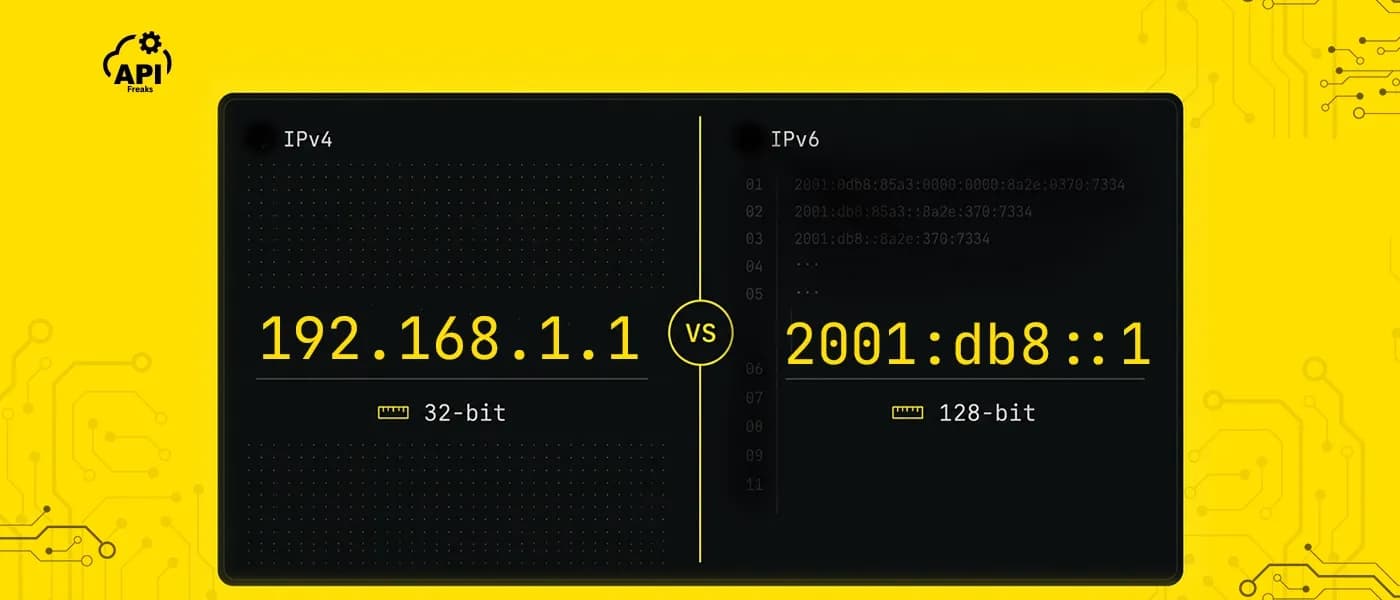

The IPv4 vs IPv6 question comes up the moment you start working with IP data at any real depth: geolocation, threat intelligence, rate limiting, logging. This guide covers the differences that actually matter for developers.
TL;DR
- IPv4 is 32-bit (4.3 billion addresses); IPv6 is 128-bit (340 undecillion). IPv4's pool is exhausted, and IPv6 exists to solve that.
- IPv4 relies on NAT to stretch address space. IPv6 doesn't need it, which means devices can be directly reachable and security must be explicit.
- IPv6 has a simpler, fixed-length header, no broadcast, and native IPsec support (recommended, not mandatory since RFC 6434).
- IPv4 geolocation is more mature and precise. IPv6 city-level accuracy varies significantly by provider.
- Most environments run dual-stack today. IPv6 adoption sits at 45 to 50% globally, higher on mobile, lower in enterprise.
- For your code: validate both formats, update your DB schema, rate-limit by /64 subnet, and test geolocation with real IPv6 inputs.
What Is IPv4?
IPv4 (Internet Protocol version 4) is the original, still-dominant addressing system. Introduced in 1981 with RFC 791, it uses a 32-bit address format expressed as four decimal numbers separated by dots:
192.168.1.1
203.0.113.42
That 32-bit space supports roughly 4.3 billion unique addresses, a number that seemed enormous in the early 1980s and became a hard ceiling by 2011, when IANA exhausted the global pool of unallocated blocks. (IANA IPv4 exhaustion, 2011)
The workaround that kept IPv4 alive was NAT (Network Address Translation), which lets multiple devices share a single public IP. It works, but it introduces complexity: your application can't always tell whether it's talking to one user or ten thousand behind the same address.
What Is IPv6?
IPv6 (Internet Protocol version 6) was developed by the IETF in the mid-1990s to solve IPv4's address exhaustion problem, formally specified in RFC 2460 (1998) and updated by RFC 8200 (2017), the current IPv6 standard. It uses a 128-bit address format expressed as eight groups of four hexadecimal digits, separated by colons:
2001:0db8:85a3:0000:0000:8a2e:0370:7334
2001:db8:85a3::8a2e:370:7334  (compressed form)
The address space is effectively inexhaustible: 340 undecillion unique addresses (3.4 × 10³⁸). Every device, sensor, and IoT node on Earth could have its own public IP, with room to spare.
Key Differences Between IPv4 and IPv6
| Feature | IPv4 | IPv6 |
|---|---|---|
| Address length | 32-bit | 128-bit |
| Address format | Decimal, dot-separated (e.g., 192.0.2.1) | Hexadecimal, colon-separated (e.g., 2001:db8::1) |
| Total addresses | ~4.3 billion | ~340 undecillion |
| Header size | Variable length (20 to 60 bytes) | Fixed 40 bytes |
| Address config | Manual or DHCP | SLAAC (stateless, automatic) or DHCPv6 |
| NAT required | Yes, in practice | No |
| IPsec | Optional, external | Recommended (was mandatory until RFC 6434, 2011) |
| Broadcast support | Yes | No (replaced by multicast/anycast) |
| Checksum in header | Yes | Removed |
| Routing table size | Large, flat | Smaller, hierarchical |
| Global adoption (2026) | Still dominant in enterprise | ~45–50% (Google; brief 50% peak Mar 2026). APNIC ~43% |
Protocol Differences in Depth
Security
IPv4 was built before network security was a primary concern. IPsec was bolted on later as an optional add-on. IPv6 was originally designed with IPsec as a mandatory component, though RFC 6434 (2011) downgraded this to a recommendation after it proved impractical to require full IPsec implementation across all device types. IPv6 also makes IP spoofing harder due to its address structure and extension headers.
The practical implication for developers is that IPv6 shifts security from implicit to explicit. IPv6 removes the "accidental protection" that NAT provided in IPv4. In an IPv6 environment, devices may be directly reachable, which means security has to be intentional. Zero Trust principles and explicit firewall rules become more important, not less. An IP Threat Intelligence API can be used to surface suspicious addresses across both protocols before they become a problem. When something does warrant a closer look, the How to Investigate a Suspicious IP Address playbook covers the full investigation workflow.
Address Configuration
IPv4 devices typically rely on DHCP for address assignment, which requires a server. IPv6 supports SLAAC (Stateless Address Autoconfiguration), where devices generate their own addresses from the network prefix without needing a central server. This removes a dependency that becomes a real operational burden at IoT scale or in large distributed deployments.
Address Space and Cost
IPv4's pool is exhausted, which means new devices that need a public address must buy or lease an existing one, currently running $18 to $45 per IP on the secondary market depending on block size, down from peaks above $60 in 2021-2022. (IPv4 address price trends, i.lease, 2026) For any infrastructure you're building at scale, IPv6 is worth planning for from the start.
What This Means for IP Geolocation
IPv6 affects geolocation accuracy, particularly at the city level.
IPv4 geolocation is more precise. Decades of mapping data, stable address assignments, and registry records make it possible to resolve an IPv4 address to city level in most developed countries with high confidence.
IPv6 geolocation is improving, but still lags. IPv6 databases are newer and have less historical coverage. Country and region-level detection is reliable, but city-level precision is weaker and varies significantly by provider. Three factors drive the gap:
- NAT effects: NAT affects both protocols differently. With IPv4, many users share one IP, so the location resolves to the NAT gateway rather than the individual device. Carrier-grade NAT (CGNAT) can put thousands of mobile users behind a single address, limiting precision regardless of protocol.
- Privacy extensions: IPv6 devices can rotate their addresses periodically using RFC 4941 privacy extensions, making geolocation lookups return varying results for the same physical user.
- Block sizes: ISPs assign large IPv6 blocks to regions. Country and region resolution is reliable; city-level mapping requires continuously refreshed data.
If your application relies on accurate geolocation, use an API that supports both protocols and maintains an updated IPv6 database. The APIFreaks IP Geolocation API handles both natively.
Coexistence: How the Transition Works

Most production environments are dual-stack, supporting both protocols simultaneously. The three transition mechanisms in use are:
- Dual stack: running both protocols simultaneously on the same device or network
- Tunneling: encapsulating IPv6 packets inside IPv4 to cross infrastructure that hasn't been upgraded
- NAT64/DNS64: translating between the two protocols for mixed environments
If you need to work with both representations, the IPv4 to IPv6 Converter handles the common conversion formats including IPv4-mapped and NAT64.
In late March 2026, Google's measurement briefly crossed 50% IPv6 for the first time (peaking at 50.1% on 28 March) and has since hovered around 45 to 50%. Other trackers run lower (APNIC ~43%, Cloudflare ~40%), so on the most generous measure IPv6 has reached rough parity with IPv4. (APNIC Blog, "Google hits 50% IPv6", April 2026) Mobile networks have led adoption; enterprise and public sector networks continue to lag. (Cisco, "IPv6 in 2025: Where Are We?", May 2025)
Which Should You Use: IPv4 or IPv6?
Use both. For most developers the answer isn't a choice. Your infrastructure needs to support IPv4 for compatibility with existing systems, legacy integrations, and users on networks that haven't migrated. At the same time, any new infrastructure you build should support IPv6 from the start.
- New services: deploy dual-stack from day one
- Security tooling: don't rely on IPv4-era assumptions (NAT as a perimeter, single IP per user). IPv6 changes both.
IPv4 isn't going away soon, but building IPv4-only is accumulating technical debt that gets harder to unwind as IPv6 adoption grows.
If you're querying IP data across both protocols, the APIFreaks IP Geolocation API and IP Threat Intelligence API both accept IPv4 and IPv6 natively.
Developer Checklist: IPv4/IPv6 Readiness
- Validate both formats. Regex patterns that only match
xxx.xxx.xxx.xxxwill silently fail on IPv6 addresses. Update your validation logic to handle colons and hexadecimal characters. - Update your database schema. Storing IPs as 32-bit integers or narrow VARCHAR fields breaks for IPv6. Use VARBINARY(16) or VARCHAR(45) at minimum.
- Review rate limiting logic. Rate limiting by exact IP address doesn't work well in IPv6. A single user can send traffic from many addresses within the same /64 prefix. Limit by /64 subnet instead. The IP Subnet Calculator supports both IPv4 and IPv6 CIDR if you need to work out prefix boundaries.
- Audit your log parsers. IPv6 addresses contain colons, which break parsers that assume dotted-decimal format. Make sure your observability stack handles both.
- Test geolocation with IPv6 inputs. Don't assume your geolocation API calls work identically for both. Pass real IPv6 addresses into your test suite.
- Don't rely on "private" address ranges for security. NAT is not a security layer, and IPv6 removes it. Firewall rules and access controls need to be explicit.
Frequently Asked Questions
What is the main difference between IPv4 and IPv6?
IPv4 uses 32-bit addresses (around 4.3 billion total); IPv6 uses 128-bit addresses (around 340 undecillion). Beyond address space, IPv6 removes NAT, has a simpler fixed-length header, and was designed with IPsec as a native component.
Why do we still use IPv4 if IPv6 is available?
NAT extended IPv4's life by letting many devices share one public IP, and most existing infrastructure, software, and networks were built around it. Migrating is costly and slow. Dual-stack is the dominant model today because both protocols need to coexist during the long transition period.
Should I use IPv4 or IPv6?
Use both. IPv4 is still required for compatibility with legacy systems, and IPv6 should be part of any new infrastructure from day one. Dual-stack is the standard approach for most production environments.
Is IPv6 faster than IPv4?
In most real-world conditions the difference is negligible. IPv6 has a simpler, fixed-length header which reduces router processing overhead, and the absence of NAT removes one layer of translation. But network path, congestion, and ISP infrastructure matter far more than protocol version in practice.
Is IPv4 or IPv6 better for security?
IPv6 has a stronger native security architecture: IPsec was originally designed as mandatory (though later downgraded to a recommendation in RFC 6434), and the address structure makes spoofing harder. That said, IPv6 removes the perimeter effect of NAT, so devices can be directly reachable. Security needs to be explicit and intentional in an IPv6 environment.
Can IPv4 and IPv6 communicate directly?
No. IPv4 and IPv6 are not directly compatible. Communication between them requires a translation layer such as NAT64/DNS64, or both endpoints need to support dual-stack.
Will IPv4 be turned off?
Not in the near future. IPv4 still carries the majority of internet traffic and is deeply embedded in enterprise infrastructure. The transition to IPv6 is real but gradual. Dual-stack is the dominant model for the foreseeable future.